
Mary Ann Cotton murdered up to 21 people, including three husbands, eight of her own children, her mother, stepchildren, a lover and any one else who was inconvenient (or who she took out life insurance on).
Location: County Durham, North East England
Date 1957 -1872
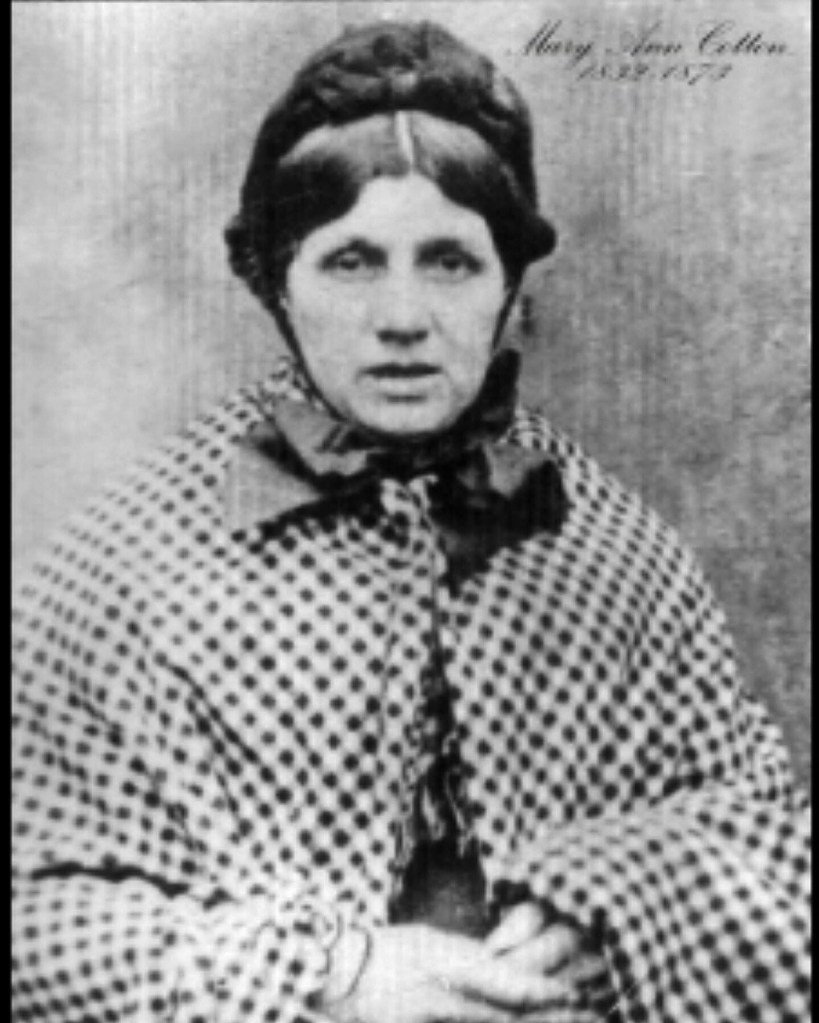
Britain’s most prolific female serial killer was born Mary Ann Robson in 1832 in a village called Low Moorsley, Tyne and Wear. She was the daughter of a miner, who died when she was just 8 years old, falling 150ft to his death down a mineshaft at Morton Colliery. His death left Mary Ann, her mother and brother in poverty.
After her mother remarried, Mary Ann, who didn’t like her new stepfather, ran away aged 16.
She worked as a nurse at Edward Potter’s home in the nearby village of South Heaton for three years then returned home and trained as a dressmaker.
Husband 1 – William Mowbray
Mary Ann, aged 20, married a colliery worker named William Mowbray at Newcastle on Tyne registry office in 1952.
They moved to Plymouth, Devon and had 5 children, 4 of whom died in infancy. Infant mortality was high at that time, but even by Victorian standards that was a high mortality rate.
Mary Ann had insured husband insured with British and Prudential insurance office for £35, which was equivalent to six months wages at the time.
She and her husband were said to quarrel frequently, and he died suddenly from an unexplained gastric illness in January 1865.
Husband 2 – George Ward
Shortly afterwards Mary Ann moved to Seaham Harbour, County Durham where she met and married George Ward in August 1865.
George was already suffering with a long illness, one of the symptoms of which was intestinal problems. However, when he died in October 1866 his doctor was suprised at the sudden unexpected nature of his death.
Again, Mary Ann collected insurance money after his death.
Husband 3 – James Robinson
By November 1866 Mary was working as a housekeeper to widower James Robinson, who was a shipwright at Pallion, Sunderland.
He had 4 children from his previous marriage who lived with him and Mary. His baby died of gastric fever a month after Mary’s arrival. She consoled him in his grief and became pregnant shortly afterwards.
At this time Mary was called away to nurse her sick mother. The mother was recovering well when she started getting sudden stomach pains and died shortly afterwards in March 1868.
Mary returned to Robinson and they married on 11 August 1867. Their child, Mary Isabella was born that November.
Their child, Mary Isabella, died 4 months later with stomach pains.
Robinson became suspicous about Mary’s insistence on taking out life insurance on him and his children. He also discovered she had got into debt and spent money that she was supposed to be taking to the bank for him.
He threw her out and was the only husband to survive her.
Husband 4 – Frederick Cotton
After being thrown out by Robinson, Mary Ann was left on the street and desperate for money. Luckily for her, in 1870 she was introduced to another widower, Frederick Cotton by his sister Margaret.
Frederick had two children from his previous marriage: Frederick Jr. and Charles. Mary moved in and became a mother to his children.
In March 1870 Frederick’s sister, Margaret, died of a stomach ailment. Mary consoled Frederick and she was soon pregnant again.
They married in September 1870. She took his name, even though the marriage was bigamous since she was still legally married to Robinson.
The couple had a son, Robert and soon after they were married the deaths started coming really thick and fast. Mary took out insurance on Frederick and his two children.
Then Frederick died in December 1871 from a gastric complaint.
Frederick Jr died in March 1872 followed shortly afterwards by baby Robert.
Things start to unravel
By this time rumours were spreading in the neighbourhood about the number of deaths that followed in Mary’s wake.
She had also mentioned to a minor government official, Thomas Riley, that Charles was “in the way” of her plans to remarry her lover. She had enquired whether Charles could be committed to the workhouse, to get him out of the way.
She told a friend that Charles was sickly and said
I won’t be troubled long. He’ll go like all the rest of the Cottons.
Mary Ann Cotton
5 days later Charles died.
Suspicion was further raised when Mary tried to collect on a life insurance policy she’d taken out on Charles. But because Charles was fit and healthy they refused to pay out until the death was investigated.
Charles’ doctor found traces of arsenic and Mary was charged for the murder of Charles.
The trial was delayed because Mary Ann was again pregnant. She delivered a baby girl on 10 January 1873 and named her Margaret Edit Quick-Manning Cotton.
Mary Ann’s Trial started on 5 March 1873.
She pleaded not guilty and seemed confident and self-assured throughout the trial. Her defence was that the arsenic had got into Charles’ system from wallpaper in the house which contained a green dye containing arsenic.
However, the jury deliberated for just 90 minutes, and Mary Ann was convicted and sentenced to death.
On March 24, 1873 she was hanged within the walls of Durham Goal at 8am in front of a group of spectators and reporters by executioner William Calcraft.
Her neck didn’t break and she slowly strangled to death taking around 3 minutes.
After her death, a cast of her head was taken to be studied at the West Hartlepool Phenological Society, and a waxwork of her joined the gallery of murderers in Mme Tussaud’s Chamber of Horrors. The description beside her read that she was executed:
For crimes for which no punishment in history could atone. The child she rocked on her knee today was poisoned tomorrow. Most of her murders were committed for petty gains’ and she killed off husbands and children with the unconcern of a farm-girl killing poultry.
Madame Tussaud’s Chamber of Horrors
Source:
Launched Into Eternity by TM Thorne
Look for the Woman by Jay Robert Nash M Evans and company Inc.
Wikepedia.org
Amazing True Stories of Female Executions by Geoffrey Abbott
Image source: https://commons.wikimedia.org/wiki/File:Mary_Ann_Cotton.jpg
 Dying for a Cuppa
