
After murdering his steward, Earl Ferrers was convicted of his murder and despite a plea of insanity and his request to be beheaded instead, became the nobleman to be hanged in England.
Location: Staunton Harold Hall, Leicestershire, England
Date: January 18, 1760

Laurence Shirley, the 4th Earl Ferrers, was born in 1720 as the eldest son to an ancient and noble family. The royal blood of the Plantagenets flowed in his veins. Aged 20, he rebelled, leaving his Oxford education and his estates and went to live in Paris, where he indulged in every excess.
Insanity was said to run in his family, and from an early age, he exhibited a violent temper and eccentric behaviour, especially when drinking, which was something he did frequently.
On one occasion, he thrashed his groom unconscious because he lost a horse race, and on another, he stabbed a servant for refusing to lie on his behalf and say a barrel of oysters had been bad when they were delivered. After stabbing him, he beat the servant unconscious with a candlestick and kicked him so hard in the groin that he was lamed for life.
Earl Ferrers inherited his title in 1745 at the age of 25. He had family estates in Leicestershire, Derbyshire, and Northamptonshire, and his main residence was Staunton Harold Hall, near Ashby-de-la-Zouch in Leicestershire.
In 1752 (age 32), he married Mary, the 16-year-old daughter of Sir William Meredith of Henbury.
However, the marriage was an unhappy one, and his wife suffered from his frequent drunken rages, womanising and violent outbursts.
In 1758, she legally separated from him, citing cruelty, something which was extremely rare at the time.
The court decreed that Mary should receive an income from his estates, and because of this, control of the estates was handed over to trustees, one of whom was an old family steward called John Johnson (the later victim).
Unsurprisingly, Earl Ferrers resented this situation. He also resented Johnson in particular, as he had testified on Mary’s behalf in the court case.
On 28 January 1760, Johnson was invited to the Earl’s mansion at Staunton Harold, Leicestershire.
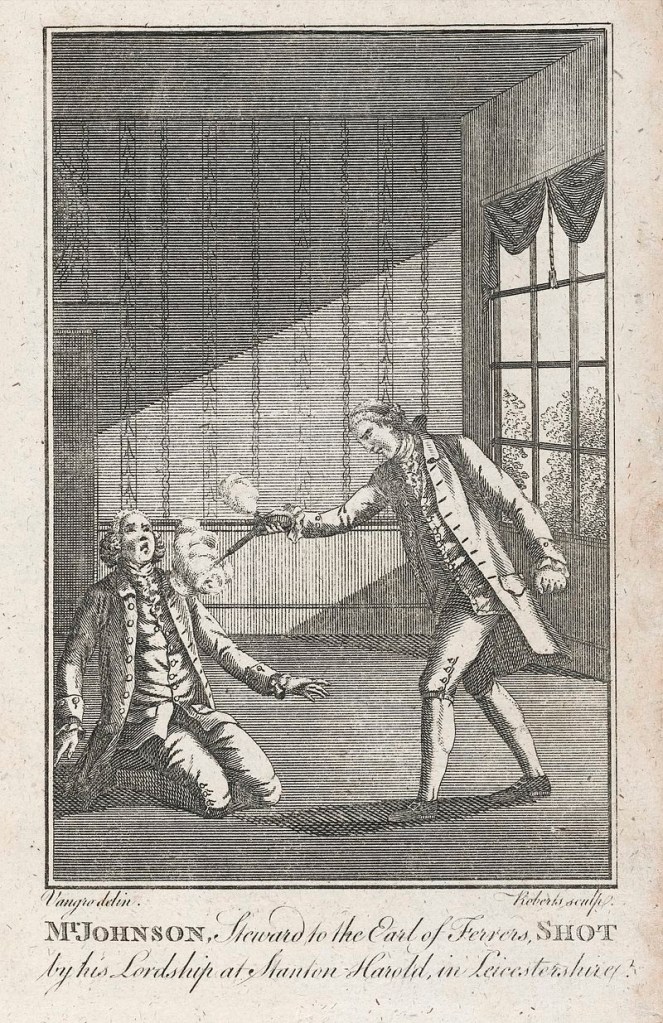
Earl Ferrers had sent away the male servants and his mistress and children before Johnson was due to arrive. When Johnson arrived, he was shown to Ferrers’ study, and after a heated argument, Ferrers shot and killed him with a pistol.
Ferrers accused Johnson of falsifying the accounts, which was quite untrue. He was overheard telling Johnson to get on one knee, then say:
Down on your other knee! Declare you have acted against Lord Ferrers. Your time has come – you must die!
Ferrers to Johnson
Following the shooting, Earl Ferrers railed and drank and ranted for hours. It was only after he went to bed about midnight that Dr Kirkland was able to remove Johnson, who at this stage was still alive, from the house. He took the man on a sedan chair to the Lount, where he died around 9am the next morning.
The following day, Earl Ferrers was disarmed and arrested by Dr Kirkland and some local men, and he was remanded to Leicester prison.
As a nobleman, he couldn’t be tried at Leicester Assises, as he had to be tried by a jury of his peers, not commoners, so he was transferred to the Tower of London on Feb 14 to await trial.
On 16th April 1760 April, Ferrers was tried in Westminster Hall. The trial lasted 2 days.
Ferrers conducted his own defence, which was a plea of insanity.
However, the Solicitor General said his temper and maltreatment of his servants were no proof of insanity.
If a man couldn’t take such action against a negligent servant, then everyone present would be in the dock!
Solicitor General
Later, Earl Ferrers revealed that he had only pleaded a defence of insanity to keep his family happy. The shame of having an insane relative was seen as far preferable to him being a common murderer.
Ferrers was found unanimously guilty by a jury of his peers.
His sentence was to be hanged by the neck until dead and then dissected. At this time, sentences were usually carried out within 2 days of the verdict (excluding Sundays), but ‘under the circumstances’, he was allowed time to get his affairs in order.
Earl Ferrers was appalled at the prospect of being publicly hanged like a common criminal and petitioned the King to be beheaded instead – a death historically reserved for noblemen. However, this was denied as beheading was only a punishment for treason committed by a peer, not murder.
On 5 May 1760, he went to the gallows dressed in the outfit he got married in, a light-coloured suit embroidered with silver. He was taken in his own carriage drawn by 6 horses from the Tower of London to Tyburn.
The hanging of a nobleman was a major public spectacle, and a new gallows was constructed for the occasion. So many people turned out to watch that it took the carriage nearly three hours to complete the short journey.
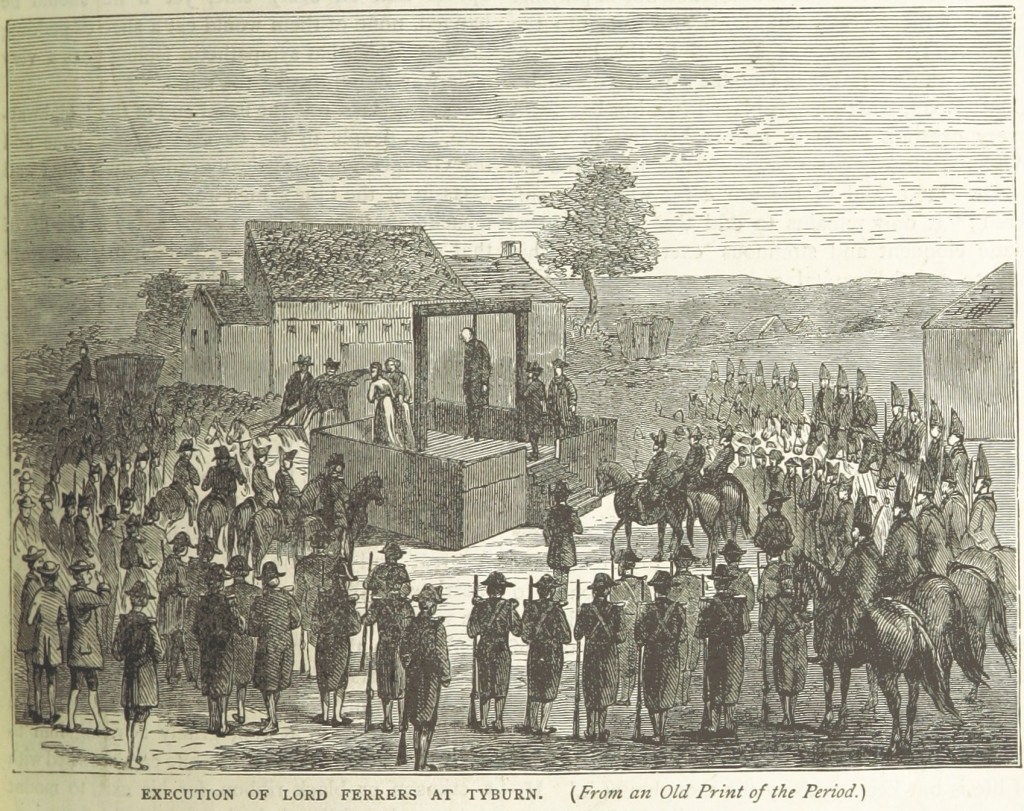
As a concession, it is said the rope used to hang him was made of silk, but this may be an urban myth.
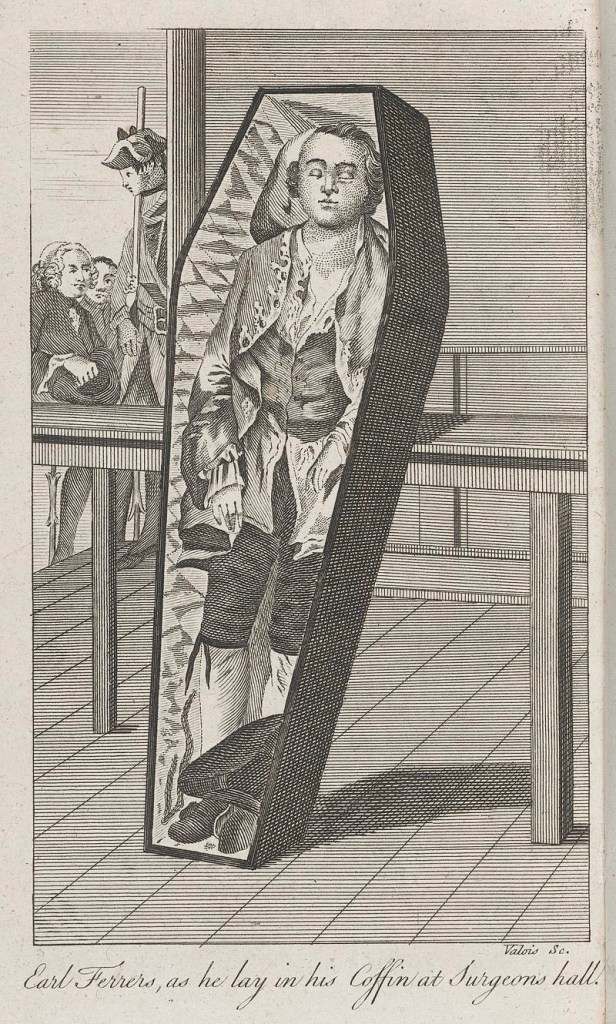
It took Earl Ferrers 4 minutes to die, and his body was left hanging for an hour before being placed in the coffin and taken to Surgeon’s Hall for dissection.
His ex-wife, Mary, remarried in 1769 to Lord Frederick Campbell, but lost her life in a house fire on 25 July 1807.
Source:
Wikipedia.org
Murderpedia.org
Image source:
https://commons.wikimedia.org/wiki/Category:Laurence_Shirley,4th_Earl_Ferrers#/media/File:Image_taken_from_page_211_of‘Old_and_New_London,etc’(11186248394).jpg
https://commons.wikimedia.org/wiki/Category:Laurence_Shirley,_4th_Earl_Ferrers#/media/File:4th_Earl_Ferrers.jpg
https://commons.wikimedia.org/wiki/Category:Laurence_Shirley,_4th_Earl_Ferrers#/media/File:Lord_Laurence_Earl_Ferrers_shooting_his_Steward,_Mr_Johnson_Wellcome_L0040866.jpg
https://commons.wikimedia.org/wiki/Category:Laurence_Shirley,_4th_Earl_Ferrers#/media/File:Lord_Laurence_Earl_Ferrers_lying_in_his_coffin_Wellcome_L0040865.jpg
 Dying for a Cuppa


