
Anderson, a young respectable mechanic from Brighton, shot and strangled his girlfriend and was hanged for it, despite pubic outrage and him not remembering anything about committing the crime.
Location: Brighton, England
Date: November 25, 1935
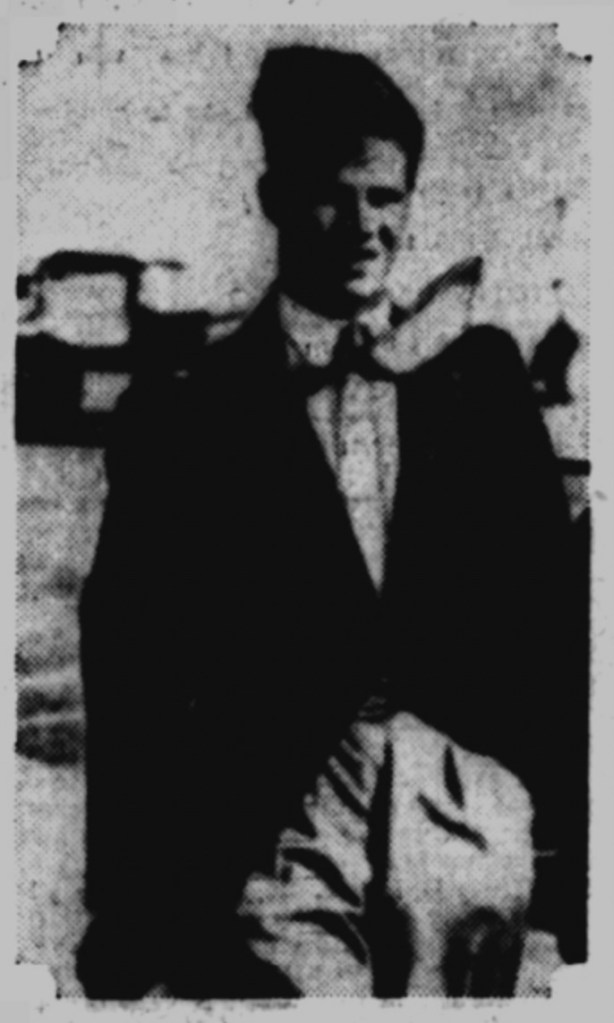
Source: Leicester Evening Mail, 9 March 1935
On November 25th 1935 the body of Edith Constance Drew-Bear was discovered in a water tank at the East Brighton Golf Course. She had been shot 5 times, with bullet wounds in her head, neck and arms, and had been strangled.
Percy Charles Anderson, a 20 year old motor mechanic who lived in Lennox Street, Carlton Hill, Brighton, was arrested for the murder.
He came from a respectable family, swam, played games and lead a healthy life. He plead not guilty and claimed to remember nothing of the crime.
Miss Drew-Bear was 21, lived in Ship Street and worked as a cashier at a restaurant near her home.
The pair met at the end of June and had been seeing each other ever since. According to Anderson, on that day, they met on the sea front at Brighton, went to the golf course and sat on the brickwork of a well.
Then she brought the subject up about my smiling at another girl. Heated words passed between us and both of us lost our tempers. Then I got a pain through my head.
Statement by Percy Charles Anderson
I started swimming for my life after that. I had to discard my hat, jacket and shoes and swim back to shore…
I don’t remember any more from the time I sat down with my young lady until the time I found myself in the sea
Sir Bernard Spilsbury, the prominent pathologist, conducted a post mortem on Drew-Bear, and stated that death was due to strangulation after the shooting had occurred. She was found with Anderson’s white scarf tied around her neck.
Mr Eric Never, acting for the defence, asked for a verdict of guilty but insane. This was rejected.
It is so difficult to see even a scintilla of evidence that this man was suffering from a disease of the mind.
Lord Hewart, the Lord Chief Justice
The jury deliberated for just 40 minutes.
When asked if he had anything to say before sentence was passed Anderson showed no emotion and replied in a clear steady voice:
If I did it, I did not know what I was doing.
Percy Charles Anderson
Anderson was found guilty at Susses Assizes at Lewis of wilful murder on March 9th, 1935 and sentenced to death.
His execution by hanging was scheduled for 9am on Tuesday, April 16 at Wandsworth Prison.
Anderson’s Brother in law, Mr Edward Heather organised a public petition for his reprieve. There was also wide public support for this, including a mass meeting on 10 December of 2000 people at the Princes Hall, Brighton calling for a reprieve for his death sentence due to him being insane at the time.
The Home Office said there were no sufficient grounds for the sentence to be changed.
Mrs van der Elst, a wealthy women who campaigned widely against the death penalty came to demonstrate on the day of his execution. A huge crowd had gathered outside the prison gates, some in support of her and some against. A police cordon had to be drawn up.
One officer was knocked down when she drove up to the prison gates as he tried to stop her car, which bore huge placards protesting against capital punishment.
Asked if she had a driving license she replied
No, I have not
Mrs van der Elst, when asked if she held a driving license after knocking down a police offer with her car
Later she spoke to reporters.
They told me I would be summoned for dangerous driving, and for not having a license and for knocking down a policeman. I am too good a driver to knock anyone down. I merely raced the engine in low gear, and the police, seeing a woman at the wheel, were frightened.
Mrs van der Elst
After the execution, which took place inside the prison, the scaffold and body were viewed by the jury, after them making a special request to the coroner. This was an unusual request and it is not clear why this was granted.
Sir Bernard Spilsbury conducted a post mortem and said the death was instantaneous and due to the dislocation of the spine.
Source:
The British Newspaper Archive
The Scotsman 2 April 1935
The Leicester Evening Mail 9 March 1935
Derby Daily Telegraph, 9 March 1935
Gloucestershire Echo, 1st April 1935, 16 April 1935
The Midlothian 17 April 1935
Lincolnshire Echo, 4 Jan 1935
Sheffield Independent, 27 November 1934
Aberdeen Press and Journal, 12 April 1935
Daily Herald, 8 April 1935
Halifax Evening Courier, 13 April 1935
 Dying for a Cuppa